
Recently, I had the honour of presenting SeriousMind’s MindEscape in Ms. Christina Boutsouki’s class at the Aristotle University of Thessaloniki (AUTH).
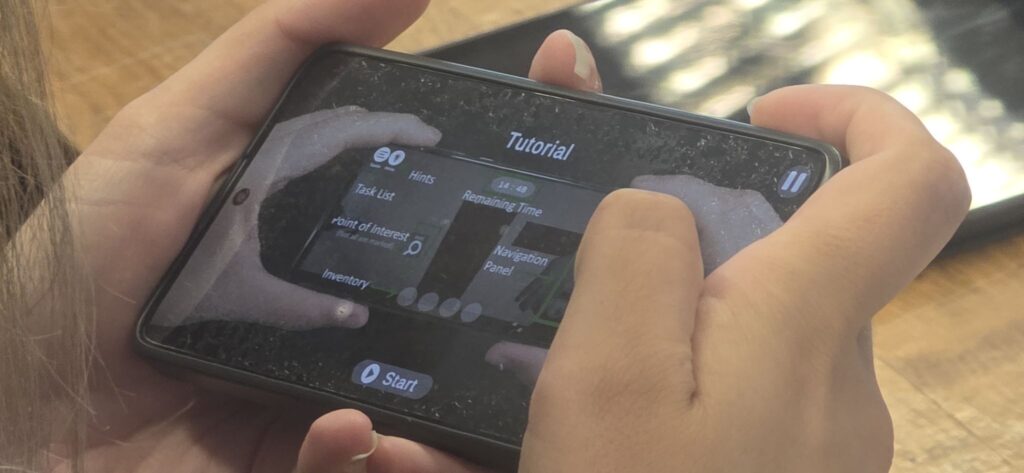
What stood out most was not the presentation or the slides. It was watching students play, engage, ask questions, and respond to the experience in real time.
When students interact directly with a serious game, the subject becomes more than a theoretical explanation. They can see how game design, neuroscience, artificial intelligence, and behavioural analysis connect in practice.
At SeriousMind, we build at the intersection of neuroscience, technology, psychology, and game design because we believe learning should be experienced—not simply consumed.
MindEscape places players inside immersive digital escape rooms where they must explore, solve puzzles, make decisions, manage time, and respond to pressure.
As students played, they became active participants in the research and product experience. They were not only hearing about personality assessment. They were experiencing how gameplay can generate behavioural data and how those patterns can be connected to a personality profile.
That shift—from listening to doing—changes the learning process.
MindEscape explores personality through the way people approach challenges.
Players may reveal different behavioural tendencies through:
These behaviours can be analysed in relation to the Big Five personality model, also known as OCEAN: Openness, Conscientiousness, Extraversion, Agreeableness, and Neuroticism.
For students, the experience creates an opportunity to ask practical questions:
This type of reflection makes concepts from neuroscience, psychology, and artificial intelligence more tangible.
The session at AUTH also represented an important connection between academic research and entrepreneurship.
SeriousMind was developed at the intersection of research, artificial intelligence, serious games, and behavioural assessment. Presenting MindEscape in a university classroom brought the technology back into the academic environment where many of the questions behind it began.
This connection is essential.
Universities create knowledge and encourage critical thinking. Startups transform research into products and experiences. Classrooms provide a space where students can examine new ideas, challenge assumptions, and imagine future applications.
MindEscape brings these worlds together by turning research on personality, gameplay, and AI into an interactive experience.
When students become curious about how their behaviour can be transformed into a personality profile, the technology starts to matter in a different way.
They begin to see that AI is not only about chatbots, automation, or prediction. It can also be used to study human behaviour, support self-awareness, and create new ways of learning.
This curiosity is important for the next generation of researchers, developers, designers, psychologists, and entrepreneurs.
It encourages students to think across disciplines:
These are not questions that belong to one field alone. They require collaboration between technology, psychology, neuroscience, education, and design.
I am grateful to Ms. Christina Boutsouki for the invitation and for creating the opportunity to present MindEscape in an academic setting. Christina Boutsouki is a professor at the School of Economics of AUTH, making the session an especially valuable connection between technology, education, and applied innovation.linkedin+1
I am also grateful to Anastasia Pagoni for her support in making the session possible, and to all the students for their energy, curiosity, and willingness to participate.
Their reactions were a reminder that innovation becomes meaningful when people can experience it directly.
Moments like this remind us why we build SeriousMind.
Our goal is not only to develop products. It is to create experiences that connect:
MindEscape is one example of what becomes possible when academic research is transformed into an interactive experience.
The most effective way to understand a new idea is sometimes not to explain it.
It is to let people play.

© 2026 SeriousMind. All Rights Reserved. Privacy Policy